awakening the adult within


awakening the adult within



“Not causing harm requires staying awake. Part of being awake is slowing down enough to notice what we say and do. The more we witness our emotional chain reactions and understand how they work, the easier it is to refrain. It becomes a way of life to stay awake, slow down and notice.”
Pema Chodron
“Awaken,” from the Old English, means to “spring into being, arise, originate” and later came to mean “wake up,” as in from a deep sleep.
Awakening the Adult Within is about seeing into your true being, into who you really are, and seeing that many of us are acting from repetitive and deeply unaware places. If you look closely (if you take the time), you will see how we keep repeating the same patterns over and over again.
Buddhist Psychology
Seeing your reactive patterns requires stopping and then looking within, or what in Zen meditation is called a “backward step.” It is where we stop, pause, and become more intimate with our experiences.
As you reflect more deeply, you see truths and delusions about your life that are hard to face. Marriages fail, addictions rage, fears flourish, while your long-standing patterns get stronger or worse and worse depending on how you look at it.
Your intention to awaken brings another view, a possibility of becoming free and seeing your inner goodness. This intention gives you a motivation to get into that boat, no matter how uncomfortable it may be or how afraid you are of the water, and cross over to a different way of being.
It’s your choice to awaken: there’s some letting go involved.
Awakening the Adult Within works with:
: the use of mindfulness & applications found in Buddhist psychology;
: contemplative approaches to cultivating positive & life-nourishing states;
: understanding old patterns and seeing/letting go of your unhealthy
reactive behaviours;
: taking responsibility for changing your life.
Above the Line, Below the Line:
A Psychology of Becoming a Responsible Adult
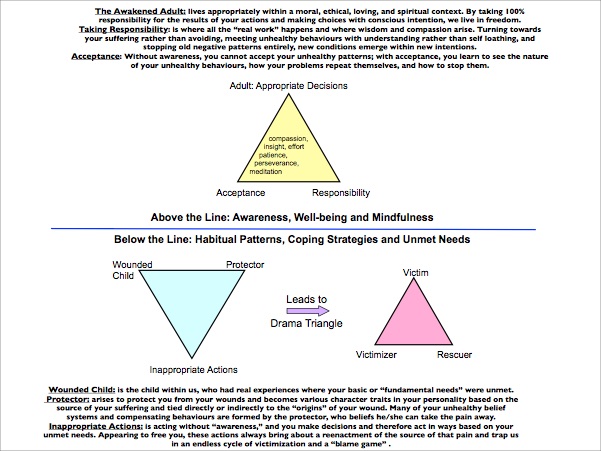
While this term originated in the advertising world, I use ‘Above the line, Below the line’, to ask: Are my actions healthy or not?
The line is your conscious awareness of the moment, which you develop through mindfulness practices that lead you to a less-reactive mind and to well-being, Without mindful awareness, it is very difficult to change your unhealthy patterns, so we stay asleep or avoid dealing with them.
In essence: living Below the Line leads me to suffering and living Above the Line leads to freedom.
While this approach is not appropriate for everyone, its goal is to reveal and help you deal with your core issues. But it must be feel right to you. If you are interested, you can speak to me by phone, skype or in person before beginning therapy.
In the course of this work, you:
First: Look beneath the surface into your long-held patterns.
Here you address and see how you go Below the Line in your life.
Combined with mindfulness practices, this process involves uncovering your core issues, patterns, and coping strategies, as well as how you react in your life, especially with others. Below the Line are the places where you fail, repeat the same patterns, or fall victim to your beliefs systems. The goal here is to become aware.
Second: Understand how your early wounds shaped you and how they affect you act today.
This involves a deeper process of honesty and self awareness, and learning how to listen to your bodily & felt senses. These sensory/feelings states are stored memories that are triggered by your life and by circumstances, and then reactivated by your neural network, the mind/body. These early feelings/thoughts/experiences shape how you perceive yourself, inwardly and with others. Without recognizing the power of these states from your early life, you are powerless to change them. These early states are born from moments when your “fundamental needs” were unmet. Without knowing how these losses and wounds continue to play out in your life, it will be difficult to fully understand how your patterns and belief systems work. Ultimately it will be impossible to be who you really are.
This work isn’t about blaming your father and mother, it is about awakening insight, loosening our attachment and loving compassion towards these long-standing patterns and the wounds from painful relationships. You learn to have compassion for your parents, grandparents and so on, but, you start with kindness embracing the wounded you and then reaching out to others.
Third: Develop new strategies to face your unhealthy patterns and use the resources of mindfulness and Buddhist practices, to change them.
You learn to pause more frequently, and instead of reacting, you learn to find compassion towards those immature parts of you. Instead of looking outside yourself for approval, love, acceptance etc., you look within to the Adult. What you didn’t get as a child cannot be replaced now by the world outside. But paradoxically, those patterns that are the source of your pain, are also the roots from which your greatest gifts have grown. With awareness you reverse the “bad habits” and lead your life with greater integrity. This is the path of living as an adult. You learn to change how you respond to others, you become more self-sufficient, and you are able to attend to your unmet needs in the moment. We still need each other, just not in unhealthy or enmeshed ways. In your life: You may ask your partner, friend, colleague, etc., for what you want. It doesn’t mean you’ll get it, it simply means that you’ll be better able to deal with the outcome.
Knowing when you are “acting out” from old habits is the first step in becoming aware. Step two means you have come to accept your patterns and issues and you are willing to take responsibility for them, which is the hardest part. Step three is refraining from the old actions and rewiring new patterns, that are healthier ones that bring relief, less suffering and enrich life.
Old patterns then become opportunities for greater awareness and even insight, and mindfulness gives you strategies to release old judgements as well as a tool that allows you to observe your negative emotions like anger, fear, jealousy and self hatred with less attachment to the feelings.
Adults know how to be responsible, which includes knowing when to ask for help.
Andrew offers individual counselling sessions, as well a weekly groups and workshops that teach the skills of Awakening the Adult Within. With new awareness that exposes what was hidden and seemingly impossible to change, you chart a new path towards a happier and more meaningful life; you cross the Great Waters.
andrew@andrewblake.ca 416-726-4219
wise teachers & mentors
“I have come to the conclusion that emotional and spiritual health is based on unconditional love, and that happy, mature people have somehow picked up the knack of being generous...while still taking care of themselves” David Richo
“Achieving genuine happiness may require bringing about a trans-formation in your outlook and your way of thinking, and this is not a simple matter.” The 14th Dalai Lama
“We must especially learn the art of directing mindfulness into the closed areas of our life.” Jack Kornfield
Waking Up to Who You Really Are